Arbitrage funds and fixed deposits both appeal to conservative investors seeking stable, low-risk returns. But they work very differently under the hood — and the gap in tax treatment alone can make a significant difference to your actual take-home returns. Here’s a clear breakdown.
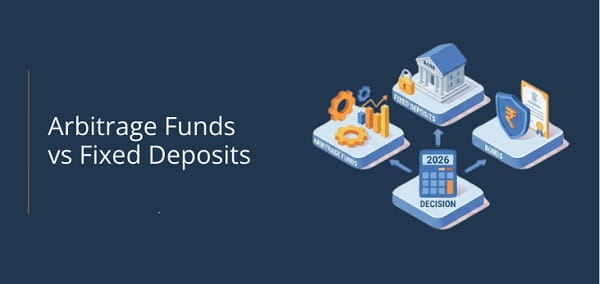
What Is an Arbitrage Fund?
An arbitrage fund is a type of equity mutual fund that exploits price differences between the cash market and futures market for the same stock. The fund simultaneously buys a stock in the spot market and sells it in the futures market, locking in a small, near-risk-free profit. Because positions are always hedged, returns are largely insulated from market direction.
Since arbitrage funds maintain over 65% in equity and equity-related instruments (including hedged positions), they are classified as equity funds for taxation purposes — a key advantage, as we’ll see.
Returns typically range from 6.5% to 7.5% per annum, similar to short-term FDs, but with better post-tax outcomes for investors in higher tax brackets.
What Is a Fixed Deposit?
A Fixed Deposit is a deposit placed with a bank or NBFC for a fixed tenure at a guaranteed interest rate. Tenure ranges from 7 days to 10 years, with current rates between 6.5% and 7.5% for most banks. Returns are predictable, principal is safe, and deposits up to ₹5 lakh are DICGC-insured.
Head-to-Head Comparison
Returns: Both deliver broadly similar gross returns of 6.5–7.5%. However, net post-tax returns differ significantly depending on your tax bracket — arbitrage funds have a clear edge here for investors in the 20–30% slab.
Risk: FDs carry virtually zero risk — sovereign and DICGC-backed. Arbitrage funds carry minimal but non-zero risk. Execution risk, liquidity risk in futures markets, and fund manager risk exist, though in practice arbitrage fund NAVs are very stable with rare negative months.
Taxation — The Critical Difference This is where arbitrage funds pull ahead sharply.
FD interest is taxed as ordinary income at your slab rate. For a 30% taxpayer, a 7.5% FD yields just ~5.25% post-tax.
Arbitrage funds held for more than 1 year are taxed as equity LTCG — 10% on gains above ₹1 lakh. Even for shorter holdings (under 1 year), they attract only 15% short-term capital gains tax — far lower than the 30% slab rate on FD interest.
For a 30% taxpayer earning 7.5% from both:
- FD post-tax return: ~5.25%
- Arbitrage fund post-tax return (held 1+ year): ~6.75%
That is a meaningful 1.5% annual difference — purely from tax efficiency.
Liquidity: Arbitrage funds are open-ended and can be redeemed anytime. Most funds process redemptions within 1–2 business days. Some funds carry an exit load of 0.25–0.5% if redeemed within 30 days. FDs allow premature withdrawal but charge a penalty of 0.5–1% on interest.
Guaranteed Returns: FDs offer completely fixed, predetermined returns. Arbitrage fund returns are not guaranteed — they depend on the spread between cash and futures prices, which fluctuates. In low-volatility markets, arbitrage opportunities shrink and returns can dip to 5.5–6%.
TDS: FD interest above ₹40,000/year (₹50,000 for seniors) attracts TDS at 10%, requiring Form 15G/15H to avoid deduction. Arbitrage funds do not deduct TDS on redemption for resident individuals, simplifying cash flow management.
Investment Amount: FDs require a lump sum. Arbitrage funds support SIP investments, though they are most commonly used for lump sum parking of short-to-medium-term funds.
When to Choose Arbitrage Funds
- You are in the 20% or 30% income tax bracket
- Your investment horizon is 3 months to 2 years
- You want FD-like stability with better post-tax returns
- You do not need a guaranteed return and can accept minor NAV fluctuations
- You want to avoid TDS deductions on interest
When to Choose Fixed Deposits
- You want completely guaranteed, predictable returns
- You are in the 0% or 5% tax bracket (tax efficiency of arbitrage funds matters less)
- You are a senior citizen relying on regular interest payouts
- Your investment horizon is very short (under 3 months) or very long (5+ years)
- You are not comfortable with any form of market-linked instrument
Final Verdict
For investors in the 20–30% tax bracket with a horizon of 3 months to 2 years, arbitrage funds are the smarter choice. They deliver similar gross returns to FDs but with significantly better post-tax outcomes, no TDS hassle, and decent liquidity. For conservative investors who prioritise guaranteed returns, capital safety, or regular income — especially retirees and those in lower tax brackets — FDs remain the right tool.
FDs guarantee your return. Arbitrage funds maximise it after tax.
FAQs
Q1. Are arbitrage funds really as safe as FDs?
A: Almost, but not exactly. FD principal is guaranteed and DICGC-insured up to ₹5 lakh. Arbitrage fund NAVs are very stable — negative monthly returns are rare — but not guaranteed. For investors who cannot afford any capital risk, FDs are safer. For those comfortable with minimal, short-term fluctuations, arbitrage funds are a strong alternative.
Q2. How are arbitrage funds taxed?
A: Arbitrage funds are classified as equity funds. Gains on units held over 1 year are taxed at 10% LTCG (above ₹1 lakh). Gains on units held under 1 year are taxed at 15% STCG. Both rates are far more favourable than FD interest, which is taxed at your full income slab rate.
Q3. What returns can I expect from arbitrage funds?
A: Typically 6.5–7.5% per annum in normal market conditions. Returns tend to be higher during periods of high market volatility (more arbitrage opportunities) and lower during calm, low-volatility periods. They are not guaranteed and can dip below 6% in flat markets.
Q4. Can I use arbitrage funds for an emergency fund?
A: Partially. Arbitrage funds are more liquid than FDs but have a 1–2 day redemption cycle and some carry a 30-day exit load. For an emergency fund, keeping a portion in a savings account or liquid fund for instant access, and the rest in an arbitrage fund, is a practical approach.
Q5. Are arbitrage funds good for short-term parking of funds?
A: Yes — this is their primary use case. Investors commonly use arbitrage funds to park surplus funds for 3–18 months, especially when awaiting a property purchase, a large expense, or a market opportunity, while earning better post-tax returns than an FD or savings account.
Q6. Do arbitrage funds pay dividends?
A: Yes, most arbitrage funds offer a dividend (now called income distribution cum capital withdrawal or IDCW) option. However, dividends are taxed at your slab rate. The growth option is generally more tax-efficient for investors in higher brackets.