IKEA is a prominent global brand in home furnishings and interior decor market. It is a Swedish conglomerate specialising in the design, manufacture and retail of ready-to-assemble furniture, home furnishings and household goods. The company focuses on affordability, functionality and democratic design. IKEA has gained a stellar reputation on the back of its Scandinavian-style, affordable and highly functional furniture, alongside its customer-first approach. Its product portfolio comprises of around 12,000 products across categories, such as living room furniture, office furniture, beds, modular kitchens, outdoor furniture, lighting, home textiles, home decor and more. IKEA became the largest retailer of furniture in the world in 2008 and continues to hold this position till date. It is also one of the world’s largest privately-held companies with a complex corporate structure. Curious about the successful business model of IKEA? Or its sources of revenue? Let’s undertake a swift analysis to satisfy your curiosity.
Basic Structure of IKEA Business Model
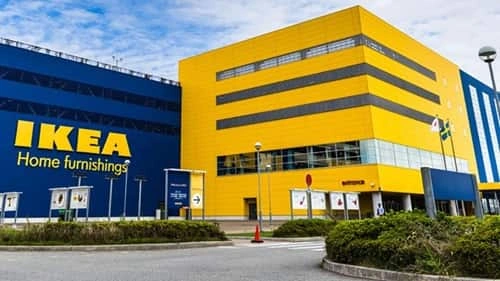
IKEA’s core business model is offering well-designed furniture and other products at affordable prices. It does not operate in the premium luxury segment. To keep the costs low, the company implements a number of strategies. Furniture products are designed to be stored and shipped in flat-pack form, which reduces transportation costs and storage costs. Moreover, since the customers can assemble the furniture themselves, there are significant savings on labour costs. The products are designed backwards to hit specific low retail prices, followed by massive production to offset the potential loss. Self-service warehouse-like retail format also helps in keeping the costs low.
IKEA operates on a B2C model, offering a wide range of products, right from essentials to premium, to cater to different needs, preferences and budgets. The company primarily targets middle-income urban consumers looking for stylish and functional furniture and home products at affordable rates.
IKEA doesn’t own most of its production facilities. Instead, it works with over 1400 suppliers across 60 countries. These suppliers not only provide production facilities but many other operational resources like wood, furniture designs and distribution facilities as well.
IKEA products are available through large stores, small format stores and a separate B2B channel for offices, hotels, restaurants and other commercial establishments. Apart from physical retail stores, the company operates its own e-commerce channel in the form of a dedicated website and mobile app, with deliveries via third-party logistics providers.
| Company | IKEA |
| Establishment Year | 1943 |
| Founder | Ingvar Kamprad |
| Headquarters | Delft, Netherlands |
| Industry | Retail |
| Net Worth | $20 billion |
| Revenue In 2024 | $28.5 billion |
How Does IKEA Makes Money?
1. Retail Sales
IKEA earns a major part of its revenue from the sales of its flat-pack furniture, home decor, accessories and other products through both physical retail stores and e-commerce. E-commerce accounts for 23% of the company’s sales. Retail sales generated around 39 billion Euros in FY25.
2. Franchisee Fees
IKEA franchisees pay 3% of their annual sales to the company in the form of franchisee fees. This fees is paid in lieu of access to IKEA trademarks, authorisation to market and sell IKEA-branded products and permission to use IKEA concept, brand and designs. Franchisee fees contributed around 1-2 billion Euros to the company’s total revenue in FY25.
3. Wholesale Sales
IKEA generates revenue by selling its products at wholesale rates to IKEA franchises and third-party distributors. Wholesale sales account for around 10% of the company’s total revenue.
4. Services
IKEA provides services like delivery, assembly and installation of products. Even though these services are provided through third-party entities, the revenues are shared.
A Brief History of IKEA
IKEA was founded in the year 1943 by Ingvar Kamprad in Almhult, Sweden. It started as a small mail order company selling cheap products like pens, wallets, watches and others. The company introduced its first furniture in the year 1948, followed by a full IKEA catalogue in 1951.
IKEA invented ready-to-assemble flat-pack furniture in 1956. The first IKEA store opened in Almhult in the year 1958. The company rapidly expanded in Europe throughout the 1970s and 80s. It entered the United States in the year 1985. IKEA opened its first store in India in the year 2018. IKEA currently has a network of over 500 retail stores across the globe.
IKEA is currently structured into Inter IKEA Group and Inga Group.